Is this where you store stress?
I think we all have a "weak area", where we tend to store our tension.
In my case, it's clearly the shoulders. When I was a translator, I used to feel my shoulders creeping up towards my ears as during the day. And I got to the evening with the distinct sensation of having had cement poured into my neck.
I thought for a long time that it was because I had bad posture. I've always been told I "sat wrong" (whatever that means), that the monitor should be at a certain height, or that my arms should rest on the aptly-named armrests.
And then I started doing yoga, and although I still sat wrong, the tension in my shoulders started to dissolve.
Of course, in my yoga practice I stretched, I strengthened and I massaged this area... but maybe more importantly, I changed the way I breathed. And considering it's something I (we) do 20,000 times a day, I believe it's what made all the difference.
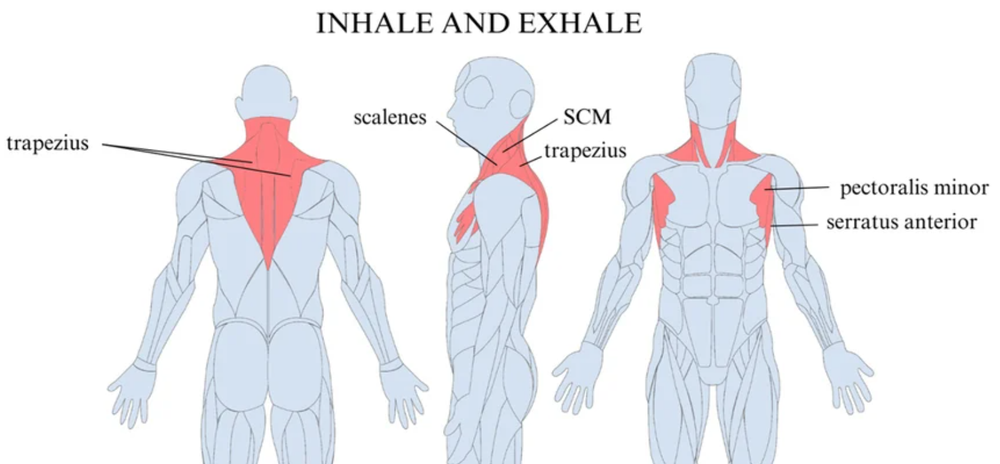
The muscles pictured above are called "accessory breathing muscles". They are supposed to assist our main breathing muscle (the diaphragm) when we need to breathe extra hard (climbing up stairs quickly or carrying groceries).
But studies show that they also tend to turn on when we're under high mental load. That's annoying, I know.
So this week I'd like you to look for 4 signals (not now while you're reading this and relaxed, but around 11am and 4pm when you're absorbed in something).
- Shoulders creeping towards your ears.
- Teeth touching. At rest, they shouldn't. There should be a small gap, tongue resting on the palate. If there's no gap, it means you're clenching your jaw.
- Holding your breath. I think you'd be surprised at how often you hold your breath without even noticing it.
- Frequent sighing. If you sigh regularly with no particular reason, it might be your body giving itself a kind of reset.
If you notice any of these, try placing one hand on your belly and one hand on your chest. And then breathe sloooowly, while trying to make the hand on your belly move. The hand on your chest should barely move.
This is called diaphragmatic breathing, and the idea is to give your accessory muscles a rest. Do this a little, often. A few minutes, several times a day can make a big difference.
Let me know how it goes!
Much love,
Clem


