If you live with persistant pain...
If you live with persistant pain, I want you to pay attention to what I'm going to share with you in this email.
I talked before about the fact that pain is always produced by the brain (you can find my post about the fascinating Snow World experiment here).
When you cut your finger, the cut sends signals up to the brain, and the brain decides whether to produce a pain experience, how intense, how alarming. We know this because the brain can produce pain without any tissue damage at all. And it can suppress pain in situations where the injury is severe, but the brain decides something else is more important (for example, soldiers in combat don't feel the pain of their catastrophic injuries until they're in safety).
So pain is not the same thing as physical sensation. Pain is the sensation, plus everything your brain layers on top of it: fear, anticipation, memory, meaning, identity...
And when it comes to chronic pain, this matters enormously. Often the injury itself has healed, but the brain's alarm system stays switched on. It keeps producing the pain experience out of habit, vigilance, or sensitisation.
This is where where mindfulness comes in. Of course, it doesn't erase the sensation, but it works on everything the brain layers on top of it.
It does so with the help of three mechanisms, documented in research:
- Disidentification. "I have back pain" slowly becomes "there is a sensation in my lower back". It sounds silly, but this tiny shift in language helps detaching the pain from our identity. You are not your pain, you are a person who experiences a variety of sensations, some of them painful.
- Decomposition. Instead of one solid block of "pain", you start to perceive texture, intensity that fluctuates, edges. As you become more familiar with the subtleties of the sensation, it often gets smaller and less terrifying.
- De-amplification. Less fear, less anticipation, less "oh no, here it comes again". Which means that the brain amplifies the pain signal less.
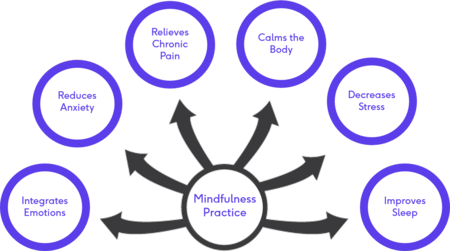
This is the foundation of Jon Kabat-Zinn's MBSR programme, which has been used in hospitals for over forty years for patients whose pain conventional medicine could not relieve.
When we think of mindfulness, we often think of meditation, but it's not the only way to practise it.
Yoga is a great way to get all the benefits of a mindfulness practice, plus the benefits of a movement practice. You get to move, exercise your body, decrease your stress and work on the three mechanisms I've shared above.
What's not to love? :)
So... something to sit with this week: the sensation in your body is one thing. The story your mind tells about it is another. You can work with the second one.
Much love,
Clem
PS: If you live with chronic pain, I would love to know how this lands. Reply to this email to let me know!


